Welcome to Mnatsakanyan Laboratory

Mitochondrial ATP synthase in Health and Disease
The mitochondrial permeability transition pore (mPTP) is a large-conductance channel of the mitochondrial inner membrane with an unknown molecular composition. mPTP plays a key role in cell physiology and pathology; nevertheless, the nature and structure of its pore-forming component remain elusive. Our lab discovered the structural gating mechanism of the ATP synthase c-subunit Leak Channel (ACLC) and its key role in mPTP. We employ a structure-based drug design approach to develop compounds that specifically target and inhibit ACLC activity in various pathological conditions, including Alzheimer's and Parkinson's diseases, ischemia-reperfusion injury of the heart and brain, and diabetes.
Check out our latest publications.
1. Cryo-EM structure of the brine shrimp mitochondrial ATP synthase suggests an inactivation mechanism for the ATP synthase leak channel.
https://www.nature.com/articles/s41418-025-01476-w
2. Bedaquiline inhibits the ATP synthase leak channel and prevents glutamate-induced neuronal death.
https://www.cell.com/biophysreports/fulltext/S2667-0747(26)00018-2
3. Investigation of mitochondrial inner membrane ion conductance by planar lipid bilayer electrophysiology.
ttps://www.frontiersin.org/journals/physiology/articles/10.3389/fphys.2026.1782998/full
Structure, Function and Regulation of Mitochondrial Permeability Transition Pore-an Enigmatic Channel of Mitochondrial Inner Membrane
Structural studies of ATP synthase and other mitochondrial complexes


Electrophysiological characterization of mitochondrial ion channels

Mitochondrial dysfunction in degenerative diseases of heart and brain

Structure-based drug design of novel therapeutic compounds targeting ATP synthase
Our Goal
From Atomic Structures to Animal Models of Human Disease
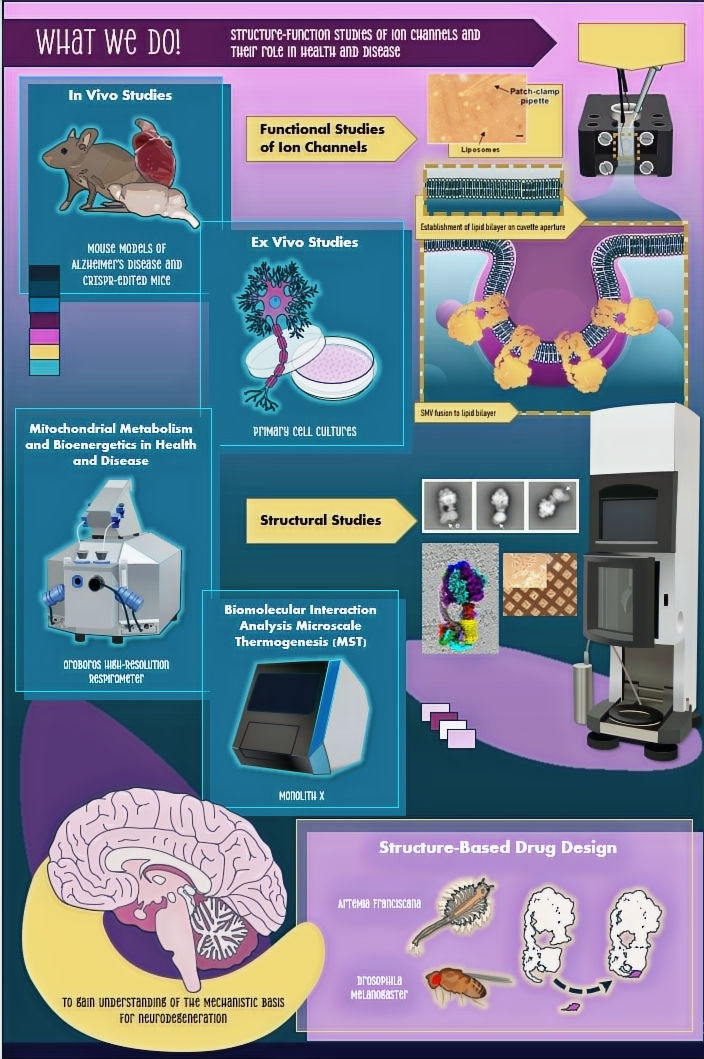
The Mnatsakanyan Laboratory studies the structure, function, and pharmacological regulation of mitochondrial ion channels with the focus on mitochondrial permeability transition pore, the enigmatic cell death channel which plays a prominent role in degenerative disorders of the heart and brain, aging, and cancer.
Our lab uses a multidisciplinary research approach combining structural biology (cryo-electron microscopy, cryo-electron tomography), electrophysiology (patch-clamp and planar lipid bilayer recordings), ligand-binding affinity (Microscale Thermophoresis) and mitochondrial physiology (Oroboros high-resolution respirometry) assays to study mitochondria-mediated cell death pathways in associated pathologies. Current projects include structure-function studies of the ATP Synthase Leak Channel and its role in Alzheimer’s and Parkinson's disease pathogenesis, diabetes, and ischemia-reperfusion injury of heart and brain.
Team
.jpg)

Postdoctorate Scholar
Olesia Lunko, PhD.

Research Technician
Erin Smith
.png)
PhD. Candidate, 5th Year Student
Ikram Mezghani
.jpg)
PhD. Candidate - 4th Year Student
Louis Betz
.jpg)
PhD Student - 3rd Year
Asantewa Anang
.jpg)
PhD Student - 3rd Year
Nora Margulis

PhD Student - 2nd Year
Chris Palles
Gallery


Join Us
POSTDOCTORAL FELLOWS, GRADUATE AND UNDERGRADUATE STUDENTS: We are always looking for talented and motivated researchers at various career stages, including undergraduate students, PhD and MD/PhD students, and postdoctoral scholars. Our lab participates in the Neuroscience and Biomedical Sciences (BMS) PhD programs at the Penn State College of Medicine. Interested prospective candidates are welcome to email their CV and statement of interest to nvm5654@psu.edu

